You're here: Main page > 3. Depot
3. Depot

The depot is located at 68 Poratzstraße, Eberswalde, Germany 16225.
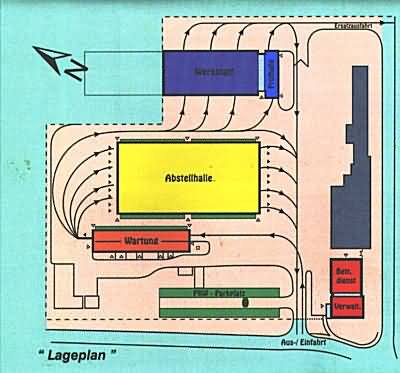
The depot Eberswalde was basicly renewed or newly built in the years 1990-1997 at an
expenditure of 10.4 millions DM. At the depot are the following main buildings:
- Maintenance hall (Wartung)
- Parking hall (Abstellhalle)
- Workshop hall with test hall (Werkstatt mit Prüfhalle)
- Administration building (Verwaltung und Betriebsdienst)
In the maintenance hall the vehicles are cleaned inside and out. Here the vehicles are
refueled with Diesel fuel (remember: the ÖAF-Gräf & Stift NGE 152 M17 type
trolleybuses have a Diesel driven emergency driving mechanism [called emergency power
generator], whereby these trolleybuses can be driven for short distances without overhead
lines), and other things are completed. Here also, a check-up of the brakes, tires and
lighting is performed.
The trolleybuses are parked in the parking hall.
The following takes place in the workshop hall : the repair of operational damage and
deficiencies, the execution of the legally required periodic general-, braking- and exhaust
gas inspections, the examination of the the tachograph, the repairing of the car body and seat
pads, the oil is changed, the exchange of spare parts, and in the long run the repair of
accident damages.
In the administration building are the management, the traffic management, the work council,
the booking office, the commercial controlling, the personnel management/account, the
administrative section of the maintenance facility as well as sanitary facilities and dining
hall.
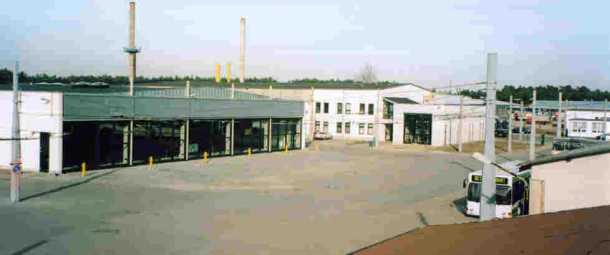
Depot with maintenance hall and new parking hall
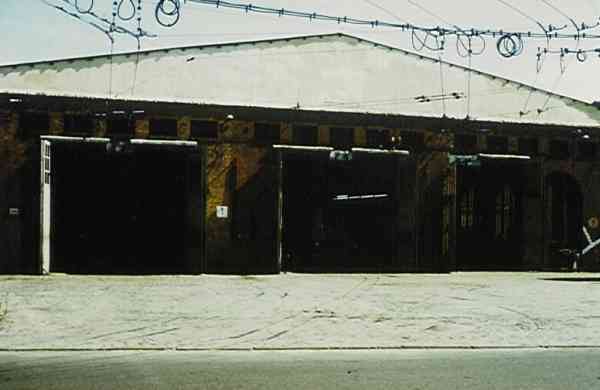
In the glaring contrast to the new depot here still a photo of the old depot in
Eberswalde, Bergerstraße